
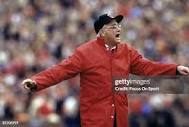
Woody Hayes: A Lasting Legacy in Buckeye Tradition
Woody Hayes is remembered as one of the most influential and controversial figures in the history of college football.
Serving as head coach of the Ohio State Buckeyes from 1951 until 1978, Hayes built a dynasty that forever shaped the identity of Ohio State football.
His tenure combined extraordinary success on the field, a deeply personal commitment to his players’ development, and a fiery personality that at times led to dramatic conflicts.
While his career ended abruptly in controversy, his influence continues to be celebrated as an integral part of Buckeye tradition, with the Woody Hayes Athletic Center standing as a tribute to his passion and accomplishments.
Born Wayne Woodrow Hayes in 1913 in Clifton, Ohio, Woody grew up in the Midwest heartland that would later define his approach to football:
tough, disciplined, and hardworking. He played tackle at Denison University before serving in the U.S.Navy during World War II.
That military background heavily influenced his coaching philosophy, particularly his emphasis on structure, discipline, and execution.
By the time he arrived at Ohio State in 1951, Hayes had already developed the leadership qualities and fiery intensity that would both propel him to greatness and contribute to his downfall.
The numbers alone tell part of the story. Hayes compiled a remarkable 205–61–10 record during his 28 seasons with the Buckeyes, making him one of the winningest coaches in college football history.
Under his guidance, Ohio State captured five national championships—in 1954, 1957, 1961, 1968, and 1970—and 13 Big Ten titles.
He also led the Buckeyes to four Rose Bowl victories, firmly establishing the program as a perennial powerhouse.
For decades, his teams set the standard for excellence in the Big Ten and across the nation.
But Hayes was not simply a coach obsessed with victories.
He was a man of strong principles, sometimes to a fault.
Known for his famous line, “Three yards and a cloud of dust,” Hayes emphasized a physical, run-heavy offense built on power and persistence.
His teams were equally tough on defense, creating a brand of football that was intimidating, disciplined, and unmistakably his own. While critics at times labeled his style conservative, few could argue with the results. His philosophy became a blueprint for generations of Ohio State teams and continues to influence the program to this day.
Beyond tactics and trophies, Hayes left an indelible mark through the players he mentored.
Many went on to enjoy successful NFL careers, but Hayes often cared just as much about what they achieved off the field.
He stressed academics, accountability, and personal growth, reminding his athletes that football was only part of their journey.
Among his most famous protégés was Archie Griffin, the only player in history to win the Heisman Trophy twice, in 1974 and 1975. Hayes also coached Howard “Hopalong” Cassady, the 1955 Heisman winner, and dozens of players who later thrived both professionally and personally thanks to his guidance.
Hayes’ fiery temper, however, was just as legendary as his success. Known for his intensity on the sidelines, he often clashed with referees, reporters, and even his own players. This uncompromising passion created unforgettable moments but also strained relationships and occasionally overshadowed his achievements.
The defining controversy came during the 1978 Gator Bowl, when Hayes struck a Clemson player after an interception sealed Ohio State’s defeat.
The incident was broadcast nationally and brought immediate consequences.
Within days, Ohio State dismissed its long-serving coach, ending his storied career under a cloud of disgrace.
Though his time at Ohio State concluded in controversy after the 1978 Gator Bowl, Hayes’ influence has never faded.
His name lives on in Buckeye tradition, honored through the Woody Hayes Athletic Center, which stands as a tribute to his passion for the game and his program. For many fans, the facility is not only a reminder of his achievements but also a symbol of the toughness, resilience, and commitment to excellence that Hayes embodied.
Hayes’ legacy is also reflected in the countless players, assistants, and fans he inspired.
His coaching tree includes numerous individuals who went on to make their own mark in football, carrying forward aspects of his philosophy while adapting to the modern game.
More importantly, his emphasis on education left a lasting cultural imprint at Ohio State.
Hayes often reminded his players, “You win with people,” underscoring his belief that character and teamwork mattered more than raw talent.
Even in his most heated moments, he wanted his athletes to leave the university not just as football players, but as prepared, responsible men.
Today, more than four decades after his departure, Woody Hayes remains both a celebrated and complicated figure in college football history.
His story is one of triumph and controversy, discipline and passion, victory and downfall.
Yet the balance of his legacy tilts firmly toward greatness.
To this day, Buckeye fans proudly recall his championships, his devotion to the scarlet and gray, and his larger-than-life presence on the sidelines.
His name endures in the fabric of Ohio State, not only in facilities and trophies but in the spirit of the program itself.
Woody Hayes was more than a coach—he was an institution.
He embodied the grit, determination, and competitive fire that define Ohio State football.
Though his final moments as a coach were overshadowed by controversy, his decades of success and his profound influence on generations of players and fans will never be forgotten.
His legacy, rooted in both triumphs and lessons, remains a cornerstone of Buckeye tradition and a powerful reminder of the lasting impact one man can have on a game, a university, and countless lives.
Leave a Reply