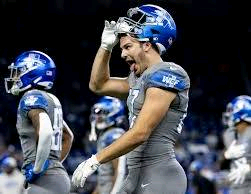

Narrative: A Rift on the Field
The locker room smelled of sweat, leather, and determination .
For months, the Detroit Lions had been grinding through the season, building a reputation as one of the toughest teams in the league.
Every practice was grueling, every game a battle, and every ounce of effort demanded total commitment.
Among the rising stars on the roster was tight end Sam LaPorta, a young player with undeniable talent, grit, and a competitive edge that sometimes spilled over into stubbornness.
Sam had worked hard to get here. Drafted with high expectations, he had delivered beyond what many thought possible for a rookie.
Game after game, he produced key catches, explosive plays, and reliable blocking.
Fans adored him. Reporters praised him.
Teammates respected his work ethic—though some quietly noted that his ambition was beginning to border on arrogance.
In the midst of his breakout season, news began to swirl around the team about salaries and contracts.
The front office had been renegotiating deals with veterans, rewarding some of the older players with extensions and pay raises.
Sam, watching these developments closely, began to feel the sting of frustration.
Despite being one of the most productive players on the field, he was still bound by the rigid terms of his rookie contract.
Compared to the sums being handed out to others, his pay felt like a slight.
At first, Sam kept his feelings quiet, confiding only to a few close friends on the team.
But resentment has a way of growing quickly in competitive environments.
Each time a headline announced another veteran’s extension, Sam’s pride took another hit.
He wanted recognition—not just in cheers or statistics, but in dollars.
The tension reached a breaking point one Thursday afternoon after practice.
The team had just finished a grueling set of drills, sweat still dripping from their helmets, when Head Coach Daniels called the group together for a post-practice huddle.
Daniels, a no-nonsense leader with decades of experience, praised the squad for their discipline and noted that leadership on and off the field would be critical for their playoff push.
But Sam wasn’t listening. His mind was elsewhere, replaying the announcement he had seen earlier that morning: another teammate had just secured a massive pay raise.
He clenched his jaw, his chest tight with indignation.
When the huddle broke, Sam approached Daniels directly.
His voice, usually respectful, carried an edge.
“Coach,” he began, “I’ve been busting my back out here all season.
I’m producing, I’m making plays, I’m putting everything on the line.
And yet, guys who haven’t done half of what I’ve done are getting paid more. Why is that?”
Daniels, caught off guard, tried to defuse the situation with calm professionalism.
“Sam, contracts and salaries are handled by the front office.
Your time will come.
Right now, focus on the team.
That’s what matters most.”
But Sam wasn’t satisfied.
His frustration, built up over weeks, spilled over.
“That’s easy for you to say, Coach.
You don’t know what it’s like to grind every game, take the hits, and then watch others cash in while you’re still on the rookie deal.
Feels like the system doesn’t respect players like me.”
The words carried a sharpness that silenced the few teammates lingering nearby.
Daniels’ eyes narrowed.
He had coached countless athletes, some with egos larger than the field itself, but rarely did he tolerate open disrespect.
“Sam,” Daniels replied firmly, “watch your tone.
Respect is a two-way street. You want to be a leader?
Leaders don’t insult their coaches or let money distract them.
They keep their focus on the game.”
But instead of backing down, Sam muttered something under his breath—something biting, something that stung.
The exact words weren’t clear to everyone, but the message was unmistakable:
Sam LaPorta had insulted his coach.
The locker room buzzed with uneasy silence afterward.
Teammates avoided eye contact, unsure whether to side with their star tight end or the coach who had guided them this far.
For Sam, the outburst brought no satisfaction—only a heavy weight that settled in his chest as he sat at his locker, replaying the confrontation in his mind.
Over the next few days, the story leaked.
Reporters picked up whispers of a “heated exchange” between LaPorta and Daniels.
Fans debated endlessly online.
Some defended Sam, saying he had every right to demand recognition.
Others criticized him, arguing that professionalism meant keeping such matters private.
Daniels handled the fallout with his characteristic steadiness.
In press conferences, he refused to fan the flames, brushing off questions and insisting that the team remained united.
“Disagreements happen in competitive environments,” he told reporters.
“What matters is how we move forward.”
For Sam, however, the incident became a turning point.
He realized that in chasing respect through money and recognition, he had risked losing the trust of the very people who mattered most—his teammates and coach.
Football, he was reminded, was not only about individual glory.
It was about sacrifice, trust, and shared struggle.
In time, the rift began to heal. Sam apologized privately to Daniels, acknowledging that his frustration had clouded his judgment.
Daniels, to his credit, accepted the apology but offered a lesson Sam would carry for the rest of his career:
“Respect isn’t bought with a contract, Sam.
It’s earned every day—in how you play, how you treat others, and how you handle adversity.”
The words struck home.
And while the salary negotiations would eventually work themselves out, the memory of that moment remained with Sam LaPorta, reminding him that sometimes the toughest battles aren’t on the field, but within one’s own pride.
Leave a Reply