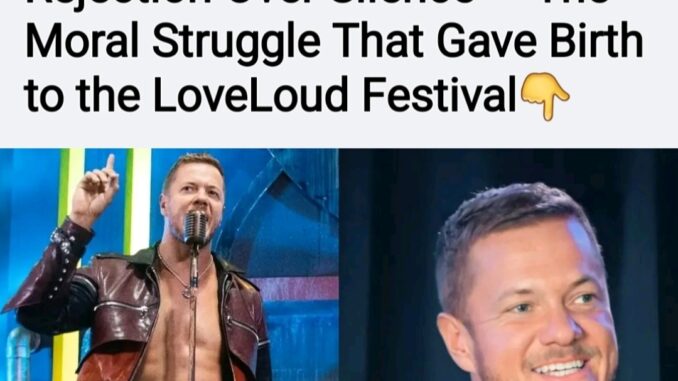
“Why Dan Reynolds Chose Rejection Over Staying Silent—The Moral Struggle That Sparked the LoveLoud Festival. Long before Imagine Dragons’ rise, Reynolds was a proud Mormon ‘golden boy.’
But after receiving thousands of heartbreaking letters about the suffering and rising suicide rates among LGBTQ+ Mormon youth, he realized that remaining quiet made him part of the problem.
Learn how he decided to openly challenge his faith’s influential institution, risking his public image to create the LoveLoud Festival—an act of conscience that pushed his community to finally confront the crisis.”
Why Dan Reynolds Chose Rejection Over Silence — The Moral Struggle That Gave Birth to the LoveLoud Festival
Long before Imagine Dragons became one of the most recognizable bands in the world, Dan Reynolds was known within his community as a model Mormon “golden boy.”
He grew up deeply rooted in the faith, shaped by its traditions, its expectations, and its belief system. For much of his youth, he fully embraced that identity.
But everything changed when he was confronted with a heartbreaking reality he could no longer ignore: the mounting despair among LGBTQ+ teens raised within the same church he loved.
Reynolds, who had once assumed that his religious community was a place of support and belonging, began receiving thousands of personal letters from young LGBTQ+ Mormons.
These letters were raw, filled with confessions of isolation, fear, and emotional pain.
Many spoke of rejection by their families and congregations; others revealed struggles with depression, hopelessness, and tragically high suicide rates among queer Mormon youth.
For Reynolds, these messages were like alarms ringing in the dark. They forced him to confront a painful truth—remaining silent made him complicit in a system that was hurting vulnerable young people.
At first, he wrestled privately with the tension between loyalty to his faith and his growing sense of responsibility.
He understood that speaking out would likely bring backlash.
Challenging a powerful institution meant risking his public reputation, his image within his community, and even his connection to the culture that raised him.
Yet as the stories piled up, Reynolds realized that choosing silence simply protected him while leaving countless young people in danger. For him, silence was no longer an option.
This internal struggle led to something bold and unprecedented: the creation of the LoveLoud Festival.
Reynolds envisioned a space where LGBTQ+ youth, particularly those from conservative religious backgrounds, could feel celebrated instead of condemned. It would be a public and unapologetic declaration that love must always come before dogma.
Launching the festival required courage—he knew it would be seen as a direct challenge to elements of his faith tradition.
But for Reynolds, the moral imperative outweighed the personal cost.
When LoveLoud finally took shape, it did more than amplify voices; it forced a conversation many had avoided. Religious leaders, families, and entire communities suddenly had to confront the pain their silence had contributed to.
The festival became a bridge—imperfect but powerful—between two worlds often at odds.
Through music, storytelling, and advocacy, it brought attention to the urgent need for acceptance and mental-health support for LGBTQ+ youth.
Reynolds’ journey from obedient “golden boy” to outspoken advocate is not a story of turning against his faith but of demanding that it live up to its own principles of compassion. He chose truth over comfort, conscience over conformity.
And in doing so, he helped open a space where countless young people could feel seen, heard, and valued.
The LoveLoud Festival stands as proof that one person’s refusal to stay silent can spark a movement strong enough to change a community.
Leave a Reply