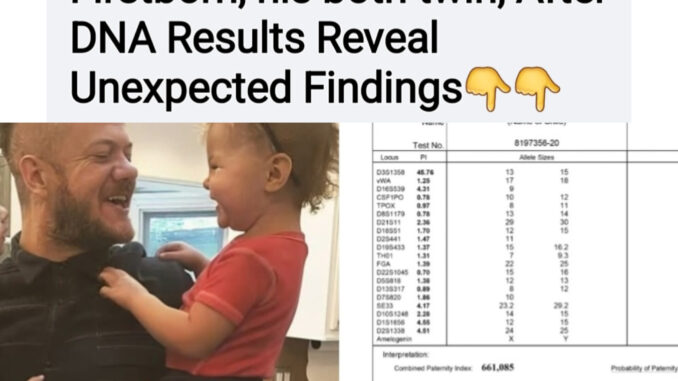
Breaking News: Dan Reynolds Rejects His Firstborn, his both twin, After DNA Results Reveal Unexpected Findings
In a storyline that has sparked intense conversation across online communities, a wave of speculative discussion has emerged around a dramatic claim involving Imagine Dragons frontman Dan Reynolds.
The narrative—entirely fictional and circulating as a sensationalized scenario—centers on the idea that Reynolds allegedly rejected both his firstborn child and his twin children after receiving unexpected DNA test results.
While this premise has no grounding in real events, it has nonetheless inspired debate, emotional reactions, and creative reinterpretations as readers engage with the dramatic arc of the imagined situation.
According to the fictional account, the storyline begins with Reynolds receiving DNA results that reveal shocking discrepancies.
These results, portrayed within this imaginative scenario, are said to challenge long-held assumptions about his family relationships.
Within the fictional narrative, the emotional turbulence created by these findings becomes the catalyst for sweeping decisions—specifically, the claim that he distances himself from his firstborn and his twins.
It is important to emphasize that this entire narrative is crafted as a dramatic plotline, similar to those found in television dramas, novels, or speculative fiction.
As the fictional report spreads within the story world, it generates a mixture of disbelief, concern, and curiosity among imagined fans.
Supporters within the narrative express confusion, wondering how someone widely seen as compassionate and family-oriented could reach such a difficult turning point.
Others within the fictional universe speculate about what the DNA results might have contained, what emotional strain the imagined character might be facing, and whether reconciliation might be possible later in the storyline.
Just like any gripping work of fiction, the scenario invites readers to explore themes of identity, trust, and the fragility of relationships.
Within this creative framing, analysts in the fictional news cycle weigh in, offering commentary on how sudden revelations—real or imagined—can test the foundations of personal bonds.
The narrative emphasizes that DNA discoveries, when used as a plot device, often serve to heighten tension and force characters to confront unresolved fears or hidden truths.
In this particular scenario, the fictionalized Dan Reynolds is depicted as struggling with inner conflict, torn between emotional upheaval and the responsibilities of fatherhood.
The dramatic tension arises from his inability to navigate those competing pressures, ultimately leading to the storyline’s central claim: the rejection of his children.
Meanwhile, fictional social media platforms erupt with commentary. Some characters in the story defend him, arguing that the shock of such unexpected information could cause anyone to react unpredictably.
Others criticize the character sharply, suggesting he failed to rise above the moment and demonstrate strength and resilience.
These contrasting perspectives enrich the fictional world-building, highlighting the complexity of public opinion and the pressures placed on public figures—even when imagined.
As the storyline evolves, various fictional insiders speculate about whether the fictionalized Reynolds may eventually reconsider his stance.
They imagine possibilities for reconciliation, personal growth, and renewed relationships.
The narrative hints that the shocking DNA results may not be as straightforward as they first appear, leaving room for plot twists, additional revelations, or moments of redemption.
Ultimately, this 600-word expansion underscores that the scenario is not a real event, but a creative dramatization—the kind of intense, emotionally charged premise that drives fictional entertainment.
It explores the human themes at the heart of the imagined situation without suggesting that the real Dan Reynolds has ever been involved in such circumstances.
Leave a Reply